MSO Vault
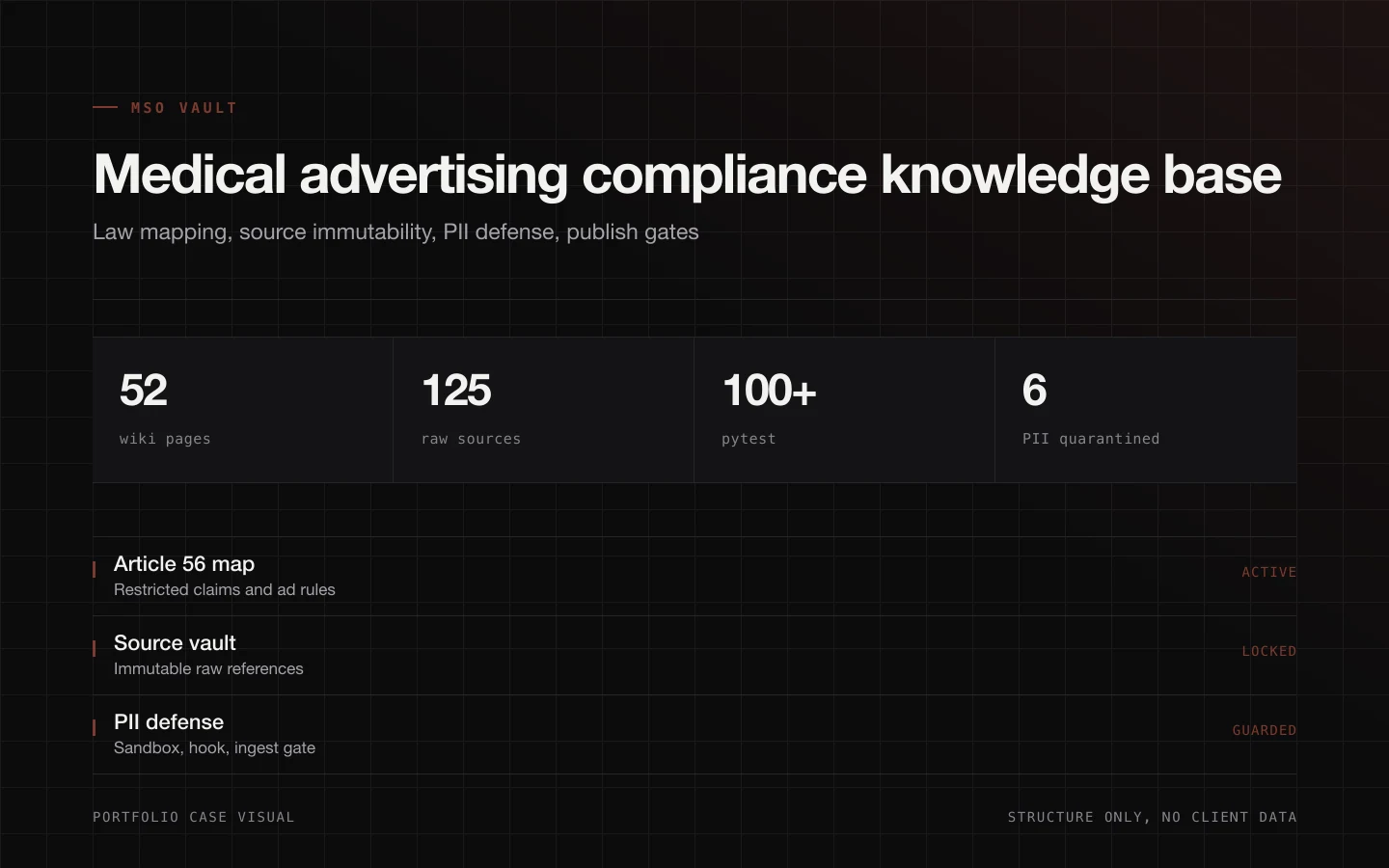
An operations knowledge base that structures medical-ad-law rules, internal guidance, and raw sources behind PII defense and source immutability.
This screen carries client operating data, so the case study shows architecture and representative screens instead of a public link.
Overview
Ad-law rules, internal guidance, and raw source material were scattered across whoever's folder they landed in. I pulled them into one searchable compliance layer.
Statutes and restricted claims are broken into wiki pages and rule units, then wired up as pre-publish checks. Patient data has to clear an OS sandbox, a PreToolUse hook, and an n8n ingestion gate before it enters, and anything ambiguous is quarantined rather than admitted.
Left as a document archive, nobody opens it. The point was to turn rules people were supposed to memorize into constraints a system can check.
Core skills
Implementation
- 1Mapped Medical Service Act Article 56 and restricted claims into wiki pages and rules used before publication.
- 2Combined OS sandboxing, PreToolUse hooks, and n8n ingest gates to keep patient data from leaking out of the knowledge base.
- 3Kept source files immutable and updated only derived outputs for auditable operations.
Strengths
- Combines laws, internal operating docs, and source files into one searchable compliance layer.
- Applies fail-closed PII handling, including name-only blind spots, quarantining uncertainty.
- Increases marketing throughput while making pre-publication review system-enforced.
Metrics
Tech stack
Screenshots