Deterministic SEO/AEO/GEO automation platformMVP
SearchOps AI
A TypeScript monorepo that runs crawl, analyze, workorder, and recheck loops deterministically without LLM dependence, isolating AI inside a replaceable ai-core.
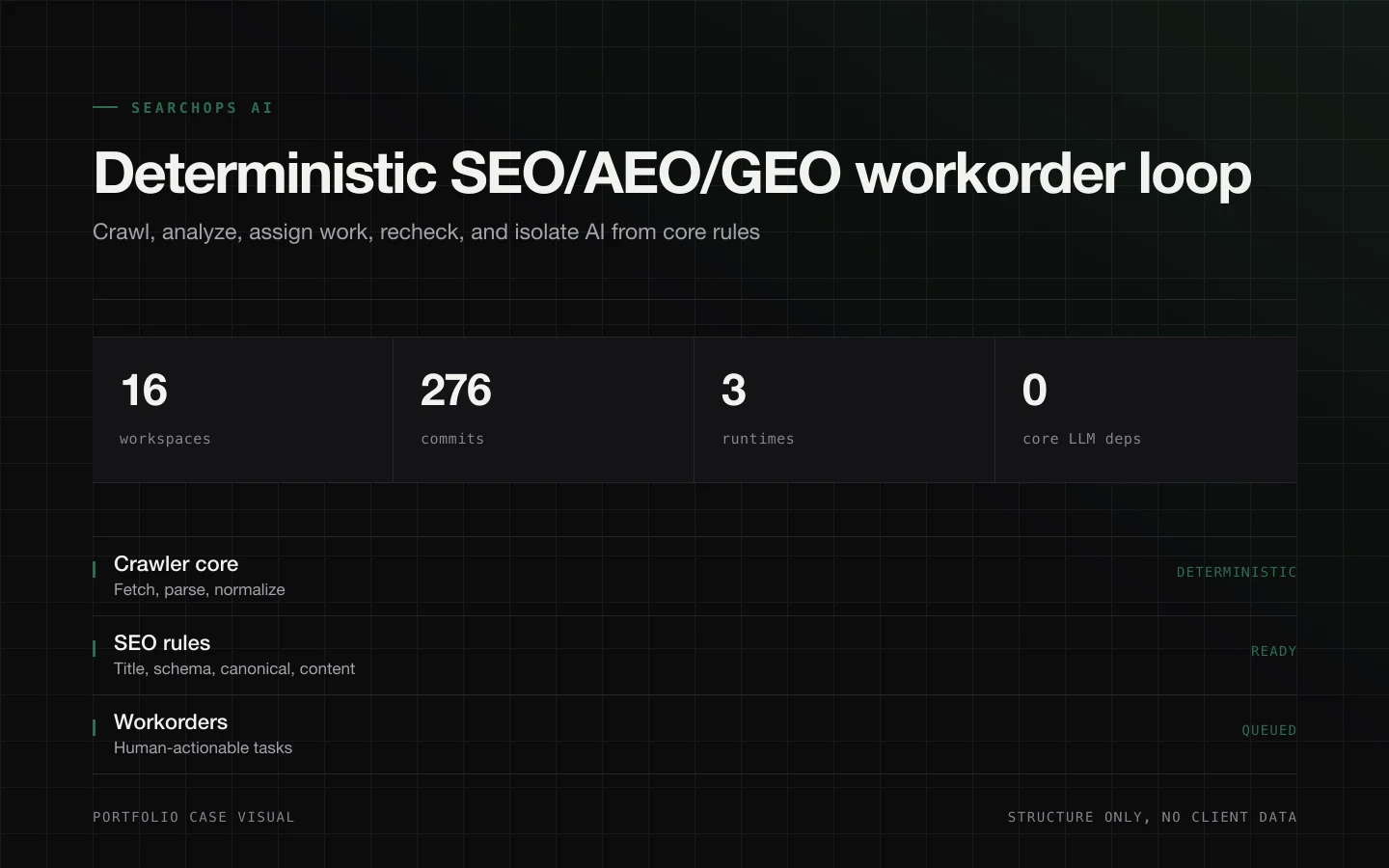
Overview
A monorepo that closes SEO, AEO, and GEO work into a loop: crawl, analyze, workorder, recheck.
I kept the rule engine off LLMs entirely. A verdict should not move because a model changed or an API went down, so AI lives only inside a replaceable ai-core package. The API, web app, worker, connectors, and rule engines are split so each can grow on its own.
There are already plenty of tools that produce one report and stop. I wanted it to hand a person a workorder they can act on, then come back later and close it with a recheck.
Core skills
Rule-based SEO/AEO/GEO engine design
Monorepo boundaries, runtime separation, and workorder modeling
GSC, GA4, PageSpeed, and CMS connector boundaries
Implementation
- 1Split responsibilities across apps/api, apps/web, apps/worker, and packages/*, then documented dependency rules.
- 2Kept the SEO core independent from AI packages so rule execution and rechecks remain reproducible.
- 3Modeled workorders as human-actionable tasks and closed them through a recheck loop.
Strengths
- Separates core SEO judgment from LLMs so the same input produces the same output.
- Defines clear boundaries across 13 packages and 3 apps for extension and testing scope.
- Includes medical compliance plus AEO/GEO rules inside the operations loop.
Metrics
16
workspaces
276
commits
3
runtimes
0
core LLM deps
Tech stack
TypeScriptNext.js 15FastifyPrisma 6PostgreSQLRedisBullMQTurborepopnpm
Screenshots