Premium AI saju appLive
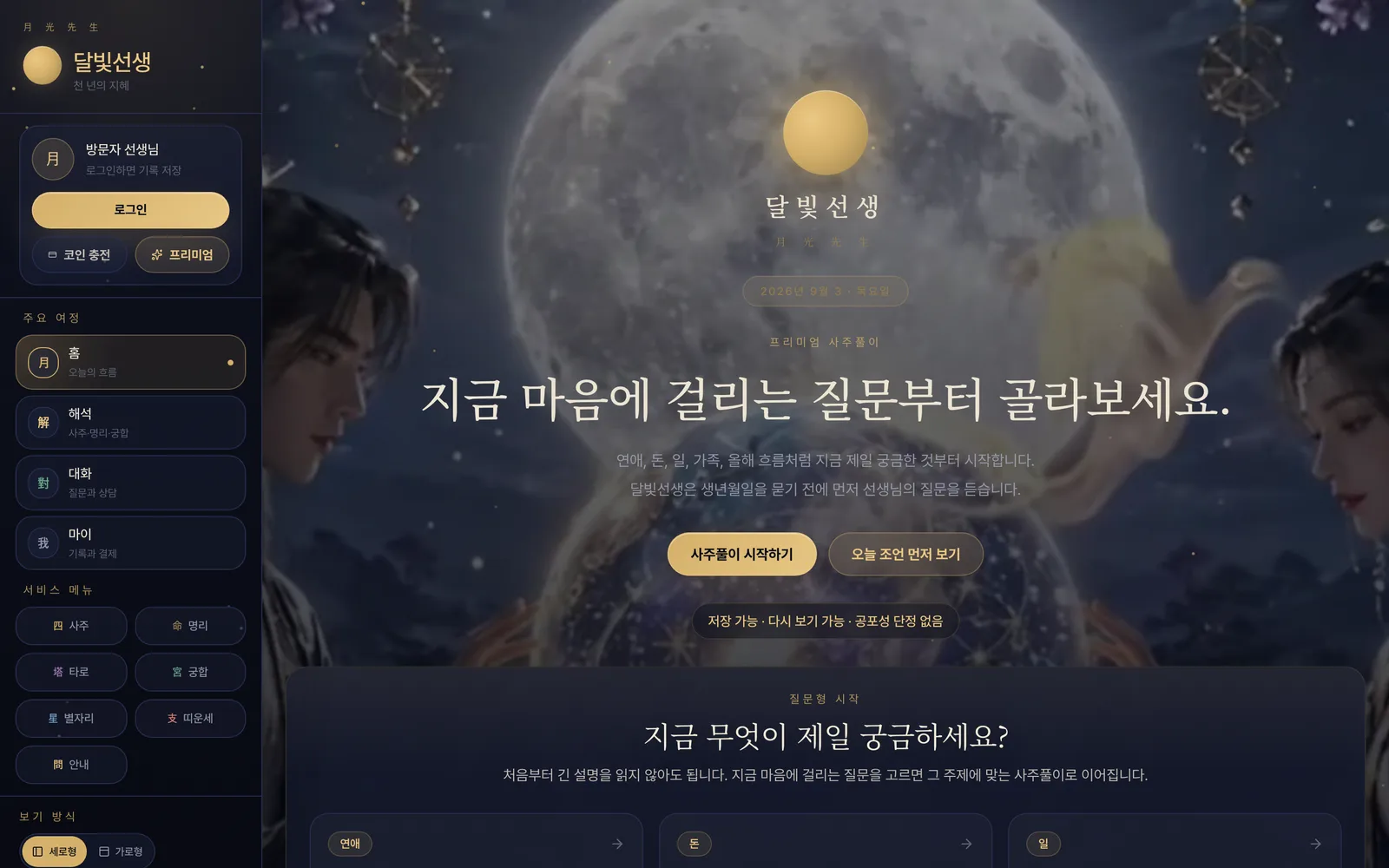
Saju AI (now Dalbit Seonsaeng)
A premium mobile saju app that grounds OpenAI readings with classical citations and experiments with membership, coins, and collectible reports.
Earlier sibling build of Ganji Saju
Overview
The premium saju app I built before Ganji Saju, put together quickly to find out whether a mobile consultation UX and a paid-content flow would hold up.
OpenAI readings are backed with classical citations, and I ran three monetization models at once: membership, coins, and collectible reports. The flow covers Toss payments, entitlement persistence, reading history, and web push.
What I learned here is what carried over into Ganji Saju.
It now runs as Dalbit Seonsaeng, with a new name and a rebuilt interface. The screenshots below are that current version.
Core skills
AI interpretation UX and classical-source grounding
Membership, coin, and report-based monetization design
Mobile-first, dark-mode, and web-push experience design
Implementation
- 1Built a mobile consultation-style UX with Next.js 16, Tailwind v4, and shadcn/ui.
- 2Connected Toss payments, entitlement persistence, and reading-history archive for paid content.
- 3Designed web-push touchpoints around morning, noon, evening, weekly, and monthly cadences.
Strengths
- Validated product direction, payment flow, and interpretation experience in an early build.
- Uses classical citations so generated content does not rely only on tone.
- Established the monetization and mobile UX foundation that later expanded into Ganji Saju.
Metrics
223
commits
3
revenue streams
5
push cadences
Tech stack
Next.js 16TypeScriptReact 19Tailwind v4shadcn/uiSupabaseOpenAI APIToss Paymentsweb-push
Screenshots